Showing posts with label The Sexual Person. Show all posts

Thursday, January 5, 2012

Reactionary "Catholic" Moral theology, cutting the foot to fit the shoe.


The Hartford Archdiocese wants gays and lesbians to practice abstinence in the New Year.
On Tuesday, the archdiocese announced it was launching a local chapter of a national ministry called Courage "to support men and women who struggle with homosexual tendencies and to motivate them to live chaste and fruitful lives in accordance with Catholic Church teachings."


1. This is wrong within the realm of current Catholic moral theology.


The following book description of “The Sexual Person” by Professors Todd A. Salzman and Charles E. Curran is found on Amazon Press.


"Two principles capture the essence of the official Catholic position on the morality of sexuality: first, that any human genital act must occur within the framework of heterosexual marriage; second, each and every marriage act must remain open to the transmission of life. In this comprehensive overview of Catholicism and sexuality, theologians Todd A. Salzman and Michael G. Lawler examine and challenge these principles. Remaining firmly within the Catholic tradition, they contend that the church is being inconsistent in its teaching by adopting a dynamic, historically conscious anthropology and worldview on social ethics and the interpretation of scripture while adopting a static, classicist anthropology and worldview on sexual ethics.

While some documents from Vatican II, like Gaudium et spes ("the marital act promotes self-giving by which spouses enrich each other"), gave hope for a renewed understanding of sexuality, the church has not carried out the full implications of this approach. In short, say Salzman and Lawler: emphasize relationships, not acts, and recognize Christianity's historically and culturally conditioned understanding of human sexuality. The Sexual Person draws historically, methodologically, and anthropologically from the best of Catholic tradition and provides a context for current theological debates between traditionalists and revisionists regarding marriage, cohabitation, homosexuality, reproductive technologies, and what it means to be human. This daring and potentially revolutionary book will be sure to provoke constructive dialogue among theologians, and between theologians and the Magisterium."


The critical piece in the thinking of Salzman & Lawler is to view/understand human sexuality not as merely a physical act; but rather, in the context of human relationships. What makes the sexual act morally good, or bad, is not the act per se, but the relationship between the two people engaging in the act.


2. It is wrong because it ignores the findings of science; the American Psychological Association states the following on this subject,


"The longstanding consensus of the behavioral and social sciences and the health and mental health professions is that homosexuality per se is a normal and positive variation of human sexual orientation (Bell, Weinberg & Hammersmith, 1981; Bullough, 1976; Ford & Beach 1951 ; Kinsey, Pomeroy, & Martin, 1948; Kinsey, Pomeroy, Martin, & Gebhard, 1953 ). Homosexuality per se is not a mental disorder (APA, 1975). Since 1974, the American Psychological Association (APA) has opposed stigma, prejudice, discrimination, and violence on the basis of sexual orientation and has taken a leadership role in supporting the equal rights of lesbian, gay, and bisexual individuals (APA, 2005).

APA is concerned about ongoing efforts to mischaracterize homosexuality and promote the notion that sexual orientation can be changed and about the resurgence of sexual orientation change efforts (SOCE)1. SOCE has been controversial due to tensions between the values held by some faith-based organizations, on the one hand, and those held by lesbian, gay and bisexual rights organizations and professional and scientific organizations, on the other (Drescher, 2003; Drescher & Zucker, 2006). Some individuals and groups have promoted the idea of homosexuality as symptomatic of developmental defects or spiritual and moral failings and have argued that SOCE, including psychotherapy and religious efforts, could alter homosexual feelings and behaviors (Drescher & Zucker, 2006; Morrow & Beckstead, 2004). Many of these individuals and groups appeared to be embedded within the larger context of conservative religious political movements that have supported the stigmatization of homosexuality on political or religious grounds (Drescher, 2003; Southern Poverty Law Center, 2005; Drescher & Zucker, 2006)."

3. Finally this is wrong because it places an inhuman life long burden on children who happen to have a same-sex orientation.

All of these theological and scientific discussions may be very stimulating and even entertaining; however, the real effect of these abstract ideas is made concrete in the lives of real people. The American Psychological Association states,


“According to current scientific and professional understanding, the core attractions that form the basis for adult sexual orientation typically emerge between middle childhood and early adolescence. These patterns of emotional, romantic, and sexual attraction may arise without any prior sexual experience. People can be celibate and still know their sexual orientation-–be it lesbian, gay, bisexual, or heterosexual.”


Imagine yourself at the age described by the APA in the preceding statement. Further imagine yourself at Sunday Mass with your family and hearing the “Courage” message from the pulpit. Imagine how your classmates hearing the same message would view you, if they “knew.”

Listen now to the words of a young Rabbi,

“You lay impossible burdens on men but will not lift a finger to lighten them.” Luke 11: 46

• Telling a child that there is something inherently defective about them as a person is evil.
• Telling them that they may never date, hold hands, fall in love with or marry the person they are naturally attracted to is evil.
• Telling them that they must live their life alone for the next 50, 60, 70, etc years is evil.
• Doing all of this in the name of God while claiming to be “compassionate” is both evil and a blasphemy.

This is the real sin here and it is the sin of the bishops who close their eyes to the truth in order to advance their careers and make an idol of an institution while forgetting God who is love and the people who they were ordained to serve.

Friday, September 23, 2011

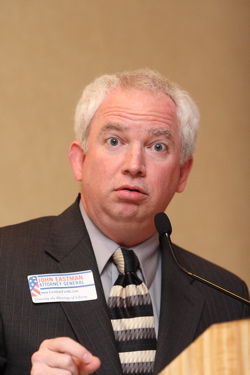
How to beat John Eastman, NOM's new spokesperson, in public debate


The Associated Press reports the following, re-printed by the Huffington Post:


"A law school professor from Southern California was named Thursday as the new chairman of the National Organization for Marriage, one of the most active groups opposed to the legalization of same-sex marriage.
John Eastman, a professor and former dean at Chapman University Law School in Orange, Calif., will replace NOM's co-founder, Maggie Gallagher, who will remain a member of the board while devoting some of her time to finishing a book about the same-sex marriage debate.


Eastman, a former clerk to U.S. Supreme Court Justice Clarence Thomas, ran unsuccessfully last year for state attorney general in California, though he did garner support from some tea party activists."


In confronting John Eastman, the new spokesperson for NOM, I would suggest using material presented in Professors Salzman and Lawler’s recent book, “The Sexual Person.” ISBN: 9781589012080 (1589012089)


The Huffington Post re-published an interesting article by Phyllis Zangano on “The Sexual Person” on 29 September 2010,


"Salzman and Lawler's dense academic argument turns traditional Catholic teaching on natural law on its head. They redefine natural law, saying "nature" is personal and individual, and that sexual activity need not be directed at procreation (contrary to what the Catholic Church has always said).

Salzman and Lawler argue that what is "natural" for a heterosexual is not "natural" for a homosexual, and therefore homosexuals and heterosexuals must act in accord with their personal "natures".

In other words, if it's "natural" for a homosexual to perform homosexual acts, then--for that person--heterosexual acts would be "unnatural" and immoral. For the two professors, homosexual activity is only immoral for the heterosexual acting against his or her nature."


Georgetown University Press offers this review, for more click here,


"Two principles capture the essence of the official Catholic position on the morality of sexuality: first, that any human genital act must occur within the framework of heterosexual marriage; second, each and every marriage act must remain open to the transmission of life. In this comprehensive overview of Catholicism and sexuality, theologians Todd A. Salzman and Michael G. Lawler examine and challenge these principles. Remaining firmly within the Catholic tradition, they contend that the church is being inconsistent in its teaching by adopting a dynamic, historically conscious anthropology and worldview on social ethics and the interpretation of scripture while adopting a static, classicist anthropology and worldview on sexual ethics."


Professors Salzman and Lawler’s work is a very important tool in our battle for Full Federal Legal Equality, because “Natural Law” arguments form the philosophical foundation for Anti-Equality laws and policies. Salzman and Lawler's arguments transform Natural Law into our ally for full Equality and should be required reading for anyone debating John Eastman, Robert George and other NOM spokespersons.

Thursday, August 11, 2011

Justice is to Law, as Healing is to Medicine


Last Tuesday evening I had the privilege of hearing a presentation on the history of marriage in California law by former State Supreme Court Justice Carlos Moreno. In his presentation Justice Moreno recounted how California’s State Supreme Court overturned the ban on interracial marriage in 1948, 19 years before the U.S. Supreme Court issued its landmark ruling in Loving v. Virginia.


"Richard Loving was white; his wife, Mildred, was black. In 1958, they went to Washington, D.C. — where interracial marriage was legal — to get married. But when they returned home, they were arrested, jailed and banished from the state for 25 years for violating the state's Racial Integrity Act. Judge Leon Bazile wrote: "Almighty God created the races white, black, yellow, Malay and red, and he placed them on separate continents. ... The fact that he separated the races shows that he did not intend for the races to mix."


Justice Moreno quoted Judge Bazile’s sentencing statement. In August of 2011, Bazile’s statement is (almost) universally seen for what it is, a monstrously ignorant, unjust and bigoted statement. However, in 1958 there were many “God fearing A-mur-eh-kins” who wholeheartedly agreed with Bazile’s “Christian” theology.


Justice Moreno went on to debunk the false accusation of “activist judges.” He explained that the court does not seek to create new legislation; but rather, people come to the court to resolve real world disputes. Justice Moreno cited a case in which a woman had a hysterectomy, but still was producing viable ovum, she very much wanted to have a child. A female friend volunteered to carry the first woman’s fertilized ovum and give birth to the child. The first woman had her ovum fertilized by her husband’s semen at a clinic and then deposited into the volunteer.


During the pregnancy, the volunteer had a change of mind and the two women ended up suing each other in court. The court had to determine who was the lawful mother of the child. Pause here for a couple of moments and place yourself in the position of the Judge who had to decide this matter. Justice Moreno voiced the thoughts of many in the room, when he cited the dilemma of King Solomon having to adjudicate who was the true mother of the child.


Justice Moreno explained all the various indicators usually used to determine paternity (DNA, giving live birth, etc); however, in this particular case both parties could claim several of these. Finally, the Judge in the case used the “intent” of the parties to determine maternity and the corresponding parental rights/duties.


Advancements in human science required a reconsideration of the seemingly “unchangeable” criteria for motherhood. Yet, this “new” understanding had a very ancient precursor, since adoptive parents are not the biological parents of a child and yet, in many cases, they are much more the “true” parents than the biological parents. In short, the intent and the relationship trump the act.


I listened with great interest, since this is precisely the thesis of Professors Salzman and Lawler in their recent book, “The Sexual Person.” Todd A. Salzman is a professor of Catholic theology and chair of the Department of Theology at Creighton University. Michael G. Lawler is professor emeritus of Catholic theology at Creighton University. A review of their new book states,


“Two principles capture the essence of the official Catholic position on the morality of sexuality: first, that any human genital act must occur within the framework of heterosexual marriage; second, each and every marriage act must remain open to the transmission of life. In this comprehensive overview of Catholicism and sexuality, theologians Todd A. Salzman and Michael G. Lawler examine and challenge these principles. Remaining firmly within the Catholic tradition, they contend that the church is being inconsistent in its teaching by adopting a dynamic, historically conscious anthropology and worldview on social ethics and the interpretation of scripture while adopting a static, classicist anthropology and worldview on sexual ethics.


While some documents from Vatican II, like Gaudium et spes ("the marital act promotes self-giving by which spouses enrich each other"), gave hope for a renewed understanding of sexuality, the church has not carried out the full implications of this approach. In short, say Salzman and Lawler: emphasize relationships, not acts, and recognize Christianity's historically and culturally conditioned understanding of human sexuality. The Sexual Person draws historically, methodologically, and anthropologically from the best of Catholic tradition and provides a context for current theological debates between traditionalists and revisionists regarding marriage, cohabitation, homosexuality, reproductive technologies, and what it means to be human.”


I had an opportunity to visit with Justice Carlos Moreno after his lecture. In our conversation I thanked him for his role in serving justice and human dignity. Later that week I read a statement by the American Psychological Association,


“The American Psychological Association reaffirmed its support Wednesday for marriage equality for same-sex couples, noting that its annual convention taking place here this week provides an opportunity to call attention to the science supporting this position.


‘As the world’s largest organization of psychologists, we felt it was important to make a statement here and now to demonstrate APA’s unwavering support of marriage equality,” said APA President Carol D. Goodheart, EdD. “With the issue playing out so prominently in California, we are using the opportunity presented by our annual convention to present the growing body of science that is the foundation for our position, and that has influenced many of the legislators, judges and other public officials who are working to achieve this goal.”


On 06 September 2011 the California State Supreme Court will hear opening arguments regarding the question of legal standing of the “Yes on Proposition 8” proponents to appeal Judge Walker’s decision that Proposition 8 is unconstitutional. Justice Moreno speculated that the Federal Court thinks that these proponents stand on very “shaky [legal] ground” on Article Three to appeal Walker’s decision and therefore sought an opinion from the California Supreme Court regarding California State Law. The proceedings will be broadcast and since the Court has nothing else on the docket that day, it could be rather extensive. Get some popcorn and tune in.


In conformity with California’s Constitution, the State Supreme Court has ninety days to issue an opinion, so by 06 December 2011 our State Supreme Court may deliver a fatal blow to Prop 8.